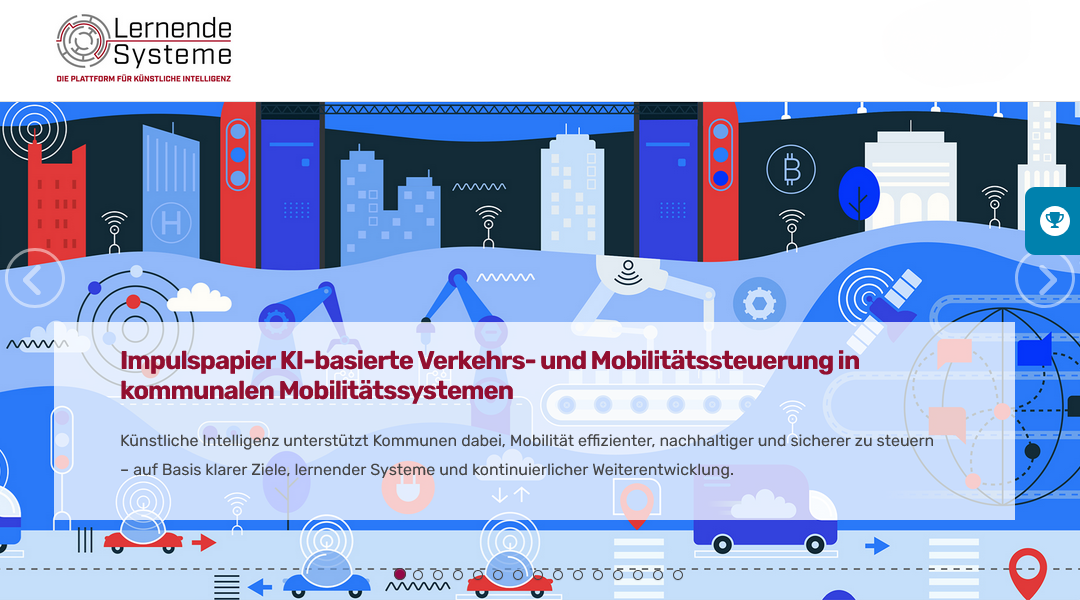
Impulse Paper from the platform 'Learning Systems': AI-based Mobility Management in Local Authorities
Where are cities and municipalities currently reaching their limits when it comes to reconciling mobility and environmental goals? This question arises in many places, particularly where increasing demands regarding climate protection, air quality and traffic flow must be met simultaneously.
Goals must be formulated clearly and precisely and defined in such concrete terms that they can be translated into measurable indicators. Only then can AI-supported systems realise their full potential in transport and mobility management. The latest impulse paper from the platform ‘Lernende Systeme‘ cites the AIAMO project as a case study, as it demonstrates how artificial intelligence can be effectively deployed in local traffic management. This is based on the AIAMO principle of ‘Decision-Driven Data Making’. The specific decision-making question determines what data is required, and how it is collated and processed.
Source: Plattform Lernende Systeme
Source: Plattform Lernende Systeme
Environmentally sensitive mobility management using AIAMO is currently being tested in practice in the pilot regions of Leipzig and Landau in the Palatinate. Traffic and environmental data are systematically linked. With the help of digital twins, this data is analysed and used for forecasts and simulations. In this way, measures can be assessed in advance with regard to the desired objectives. This provides local authorities with a sound basis for operational decisions.
In addition, standardised procedures are used which make it possible not only to analyse measures, but also to implement them in a targeted manner, monitor them continuously and adjust them as necessary. The process of translating objectives into indicators, as described in the impulse paper, thus becomes concrete and applicable in practice. Indicators are derived from decision-making questions and are always considered within the overall context.
This provides clear added value for local authorities. Measures can be assessed more thoroughly in advance, conflicting objectives become clearer, and decisions taken during day-to-day operations can be justified in a transparent and well-founded manner.
25.06.2026 - A successful AIAMO roadshow in Munich: a round-up [more...]
10.06.2026 - Public transport data for AI-based, environmentally sensitive mobility management [more...]
08.06.2026 - Latest expert article: AI for the mobility of tomorrow [more...]
02.06.2026 - AIAMO launches pilot operation in Leipzig and showcases solutions at Data Week [more...]
25.05.2026 - AIAMOroadshow goes Munich – Register Now for Free! [more...]
20.05.2026 - A fresh breeze: Modern mobility management with AIAMO – Interview with the UFZ team in the Straßenmagazin KIPPE [more...]
19.05.2026 - AIAMOroadshow goes Dresden – Register Now for Free! [more...]
06.05.2026 - Professional article in bfp Magazine: Better mobility decisions with AIAMO [more...]
23.04.2026 - New expert article on Springer Professional: Floating car data for AI-based traffic models [more...]
22.04.2026 - 6th AIAMOcamp – Focus on inplementation [more...]