AIAMO launches pilot operation in Leipzig and showcases solutions at Data Week
As part of the AIAMO – Artificial Intelligence And MObility research project, trialling of the first digital solutions for environmentally sensitive mobility management has begun in Leipzig. The applications, developed in collaboration with the city, have now been made available to the participating stakeholders from the Mobility and Civil Engineering Department, the Environmental Protection Department and the Digital City Unit for practical testing and evaluation.
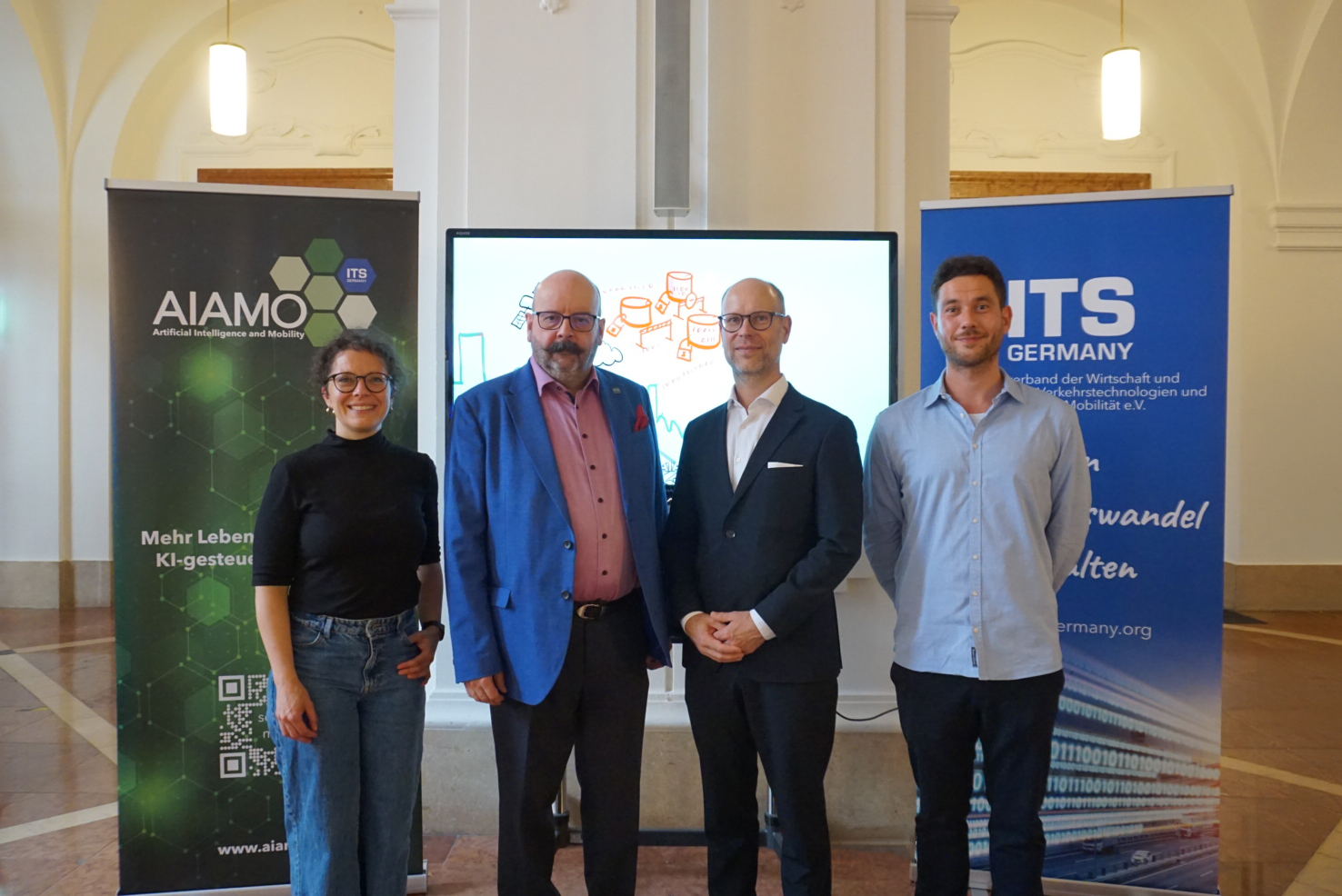
From left to right: Nadja Riedel (Digital City Department, City of Leipzig), Markus Wartha (President of ITS Germany e.V. and AIAMO consortium leader), Clemens Schülke (Mayor and Deputy Mayor for Economic Affairs, Employment and Digital Affairs, City of Leipzig) and Dr. Thomas Trabert (AIAMO project manager for the Leipzig pilot region, Helmholtz Centre for Environmental Research UFZ)
The applications enable improved assessment of traffic flow, air quality and environmental impacts, and lay the groundwork for a more informed evaluation of transport-related measures. Key components include digital twins for mobility and the environment, AI-based analysis and forecasting, and solutions for the dynamic management of traffic lights and for supporting sustainable mobility choices.
“Leipzig is pursuing the goal of making mobility more efficient, sustainable and climate-friendly. The applications developed as part of AIAMO are helping us, for the first time, to combine traffic and environmental data much more comprehensively and in real time. This will enable us to analyse and simulate the effects of various measures more precisely in future – particularly with regard to air quality, traffic flow and the requirements of the EU limit values applicable from 2030,” said Dr Beate Ginzel, Head of Digital City Leipzig.
“AIAMO translates research findings on artificial intelligence into application-oriented pilot projects for municipal mobility systems. The launch of the pilot operation is therefore more than just a technical milestone: it demonstrates how Germany can build up its own expertise in data-driven, environmentally sensitive mobility management and strengthen local authorities’ capacity to act. It is crucial that such systems are interoperable, transferable and tailored to the actual requirements of cities and regions,” says Markus Wartha, President of ITS Germany e.V. and consortium leader of AIAMO.
25.06.2026 - A successful AIAMO roadshow in Munich: a round-up [more...]
10.06.2026 - Public transport data for AI-based, environmentally sensitive mobility management [more...]
08.06.2026 - Latest expert article: AI for the mobility of tomorrow [more...]
02.06.2026 - AIAMO launches pilot operation in Leipzig and showcases solutions at Data Week [more...]
25.05.2026 - AIAMOroadshow goes Munich – Register Now for Free! [more...]
20.05.2026 - A fresh breeze: Modern mobility management with AIAMO – Interview with the UFZ team in the Straßenmagazin KIPPE [more...]
19.05.2026 - AIAMOroadshow goes Dresden – Register Now for Free! [more...]
06.05.2026 - Professional article in bfp Magazine: Better mobility decisions with AIAMO [more...]
23.04.2026 - New expert article on Springer Professional: Floating car data for AI-based traffic models [more...]
22.04.2026 - 6th AIAMOcamp – Focus on inplementation [more...]